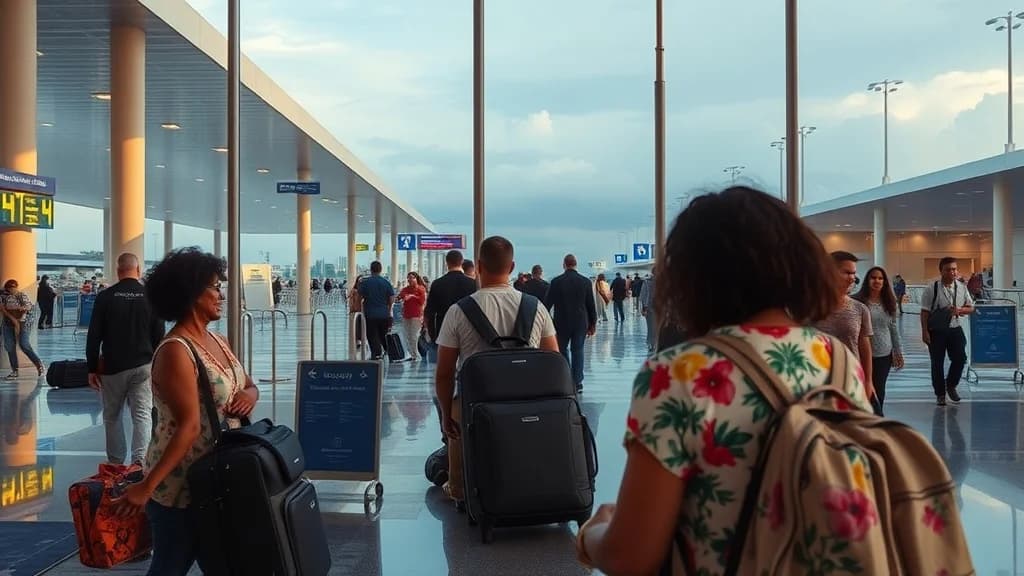
Spring break dreams turned into airport nightmares across South Florida as travelers faced a perfect storm of delays Tuesday morning. Miami International Airport and Fort Lauderdale-Hollywood International Airport became scenes of frustration as weather-related cancellations collided with ongoing impacts from the partial government shutdown, creating cascading disruptions during one of the year's busiest travel periods.
The timing couldn't be worse for South Florida's tourism-dependent economy. As families and college students flood into Miami-Dade and Broward counties for spring break festivities, the travel chaos threatens to dampen what should be a peak revenue period for local hotels, restaurants, and attractions.
Perfect Storm Hits Peak Travel Season
Travelers faced another morning of delays and long lines at South Florida airports as spring break crowds collided with weather-related cancellations and the partial government shutdown. The convergence of factors created a ripple effect that extended wait times and forced many to reconsider their travel plans entirely.
For a region that welcomes millions of visitors annually, the disruptions highlight the vulnerability of South Florida's travel infrastructure during peak seasons. Miami International Airport, typically one of the busiest gateways to Latin America and the Caribbean, found itself struggling to manage the increased passenger volume amid operational challenges.
Impact Beyond the Terminals
The airport chaos extends far beyond departure gates, affecting the broader South Florida hospitality ecosystem. Hotels in South Beach, Brickell, and Coral Gables that depend on timely arrivals for their spring break bookings now face potential cancellations and frustrated guests. Restaurant reservations in Wynwood and the Design District could see no-shows as travelers remain stranded at airports.

Design District
The Miami Design District is a premier luxury shopping, dining, and cultural destination spanning nearly one million square feet in Miami, transformed from a 1920s furniture hub into an internationally recognized neighborhood featuring flagship stores from brands including Hermès, Gucci, and LVMH labels. Spearheaded by Miami native Craig Robins' Dacra in partnership with L Catterton Real Estate and Brookfield, the district serves as South Florida's cultural epicenter with world-class architecture, contemporary art galleries, award-winning restaurants, and abundant public art installations. The district continues to expand with major developments including a 26-story residential tower designed by Pritzker Prize-winning architect David Chipperfield, featuring 143 condominium residences and a hotel component, alongside ongoing retail and office leasing that attracts global visitors and affluent residents.
Miami-area travelers should check flight status frequently, arrive at airports with extra time, and consider travel insurance during peak seasons to protect against weather and operational disruptions.
The situation underscores the interconnected nature of South Florida's economy, where tourism disruptions at airports can quickly cascade through the hospitality, dining, and entertainment sectors that make Miami a global destination. As the region continues to position itself as a gateway to Latin America and a premier vacation spot, maintaining reliable travel infrastructure becomes increasingly critical.
For now, travelers and tourism businesses alike must navigate this challenging period while hoping for clearer skies and smoother operations in the days ahead. The resilience of South Florida's travel industry will be tested as it works to accommodate displaced passengers and maintain the seamless experience visitors expect from one of America's premier vacation destinations.
Miami International Airport
Miami International Airport (MIA), owned and operated by the Miami-Dade Aviation Department, stands as America's second-busiest airport for international passenger traffic and the nation's leading gateway for international freight operations. Founded in 1928 when Pan American Airways shifted operations from Key West to Miami, MIA evolved from a modest 116-acre privately operated facility into one of the world's largest and busiest aviation hubs. The airport's transformation began when Pan American Field officially opened on January 9, 1929, with Charles Lindbergh inaugurating service to San Juan, establishing Miami as a pivotal hub for international aviation to the Caribbean, Central America, and South America. By 1949, following the consolidation of the original 36th Street Airport with the Miami Army Airfield, MIA had grown to 2,500 acres and became the world's largest aircraft maintenance and overhaul facility for commercial aviation. The airport's modern era launched on February 1, 1959, when a newly constructed Miami International Airport with five concourses and a centralized terminal—then the world's largest—officially opened at Wilcox Field on 20th Street, handling over four million passengers within its first year of operation. Today, MIA serves as the primary U.S. gateway to Latin America and the Caribbean with extensive operations from American Airlines and countless international carriers, generating billions in economic activity and supporting a multi-billion-dollar capital improvement program to meet growing demand. The airport's strategic position, coupled with its deep-rooted history as a pioneer of international commercial aviation, continues to position Miami as an essential global transportation and commerce hub.