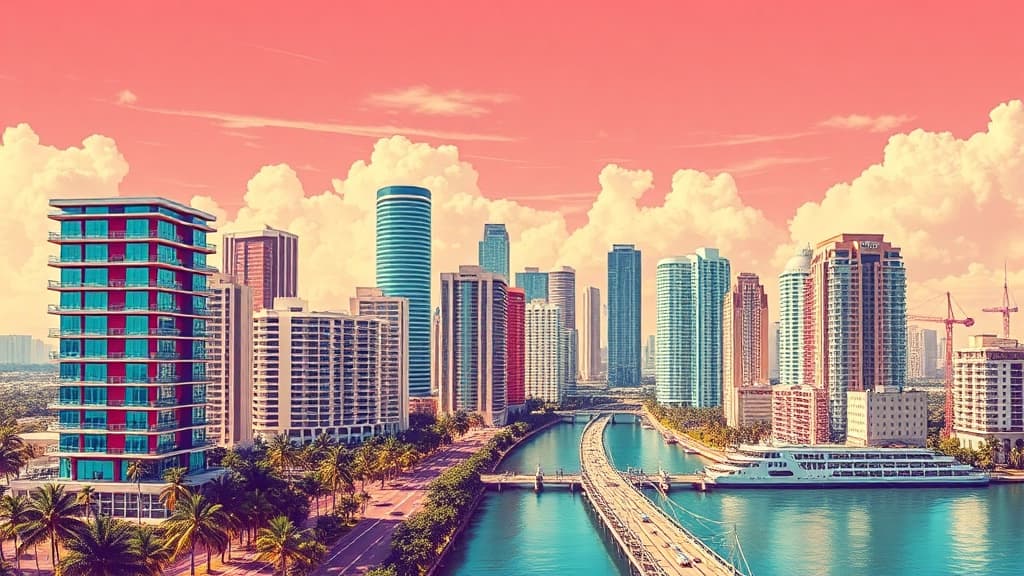
Global buyers from 73 countries have purchased 52% of new South Florida construction, pre-construction, and condo conversion units over the last 22 months ending November 2025, transforming Miami into the ultimate international real estate playground where sovereign wealth and private security converge.
These aren't just luxury purchases—they're strategic relocations to what industry insiders call Miami's "international enclaves," ultra-exclusive residential areas that function almost like private nations within the city. From the fortress-like Indian Creek Island to record-breaking sales in unexpected neighborhoods like Little Havana, foreign capital is reshaping Miami's landscape one billionaire at a time.
The Numbers Tell the Story
According to the Miami Association of REALTORS®, the international buyer share has surged from 49% in July 2025 to 52% by November 2025, with Latin Americans representing a staggering 86% of these purchases. The geographic concentration is equally telling: Miami Beach attracts 75% international buyers, Brickell commands 77%, and Coral Gables reaches an extraordinary 82% foreign ownership in new developments.
Miami now ranks as the No. 1 U.S. market for international homebuyers in Q1 2025, cementing its position as the hemisphere's premier destination for wealth migration. The November 2025 report, released in collaboration with Fortune Christie's, Cervera Real Estate, and ONE Sotheby's, reveals buyers fleeing instability across Latin America in search of what Fortune Christie's VP Daniel Guerra calls "security in investment" and relocation options.
Indian Creek: The Ultimate Billionaire Fortress
At the apex of Miami's international enclaves sits Indian Creek Island, a 300-acre private island that has earned the nickname "Billionaire Bunker." Connected to Surfside by a single, heavily monitored bridge, this community operates with sovereign-level security that makes most embassies look casual by comparison.
The island features its own 24/7 public safety department, high-tech perimeter monitoring with Israeli-designed radar and thermal/infrared cameras, and entry gates where police are notoriously "quite rude" to unauthorized visitors, according to reports from those who've attempted access. This isn't hospitality—it's fortress mentality executed with unlimited budgets.
Security as the Ultimate Commodity: Indian Creek's surveillance system rivals that of small nations, featuring thermal imaging, radar detection, and round-the-clock armed patrols—all protecting residents who view privacy and security as their most valuable assets.
Recent high-profile purchases underscore the island's magnetic pull for global tech and finance titans. Mark Zuckerberg's record $170 million purchase for an under-construction property set new benchmarks, joining a resident roster that reads like a Forbes list: Jeff Bezos, Tom Brady, Carl Icahn, Ivanka Trump, Jared Kushner, Julio Iglesias, Adriana Lima, and David Guetta.

Adriana Lima
Brazilian supermodel commanding luxury fashion campaigns and high-profile editorial features while building a selective post-Victoria's Secret portfolio in 2026.
Real estate values reflect this exclusivity premium. Homes now sell for double their prices from 4-5 years ago, fueled by Florida's tax advantages, waterfront appeal, and what industry observers describe as security becoming "the ultimate commodity" in an increasingly unstable world.
Record-Breaking Sales Beyond the Island
The international enclave phenomenon extends far beyond Indian Creek's exclusive shores. On January 27, 2026, Douglas Enclave, a multifamily community in Little Havana, sold for a record-breaking $68 million at $341,708 per apartment—surpassing the previous record of $315,217 per unit set by 850 Living.
The Astor Companies sold the property to Tandel Group 6 Properties, who plan to maintain operations, signaling confidence in Miami's rental market even as international buyers reshape ownership patterns. This sale demonstrates how global capital isn't just chasing beachfront mansions—it's systematically acquiring income-producing assets across diverse Miami neighborhoods.
Navigating the Bubble Risk
Miami's international appeal comes with significant market risks. The city leads the UBS Global Real Estate Bubble Index 2025 with a bubble score of 1.73—the highest-risk globally as of March 17, 2026. This score reflects soaring prices that have outpaced stagnant rents and exceeded 2006 crisis levels.
Yet ultra-luxury enclaves like Indian Creek remain immune to broader market concerns. While rising inventory, condo repair assessments, and climate-tied insurance costs pressure middle-market segments, the ultra-wealthy continue viewing Miami real estate as a strategic asset class rather than mere accommodation.
- Market challenges include infrastructure strain from rapid development
- Ongoing wastewater and sewage disputes affect even exclusive areas like Indian Creek
- Climate risks drive insurance costs higher across all price segments
- Inventory increases in luxury segments create buying opportunities
The New Geography of Global Wealth
Miami's international enclaves represent more than real estate trends—they're physical manifestations of global wealth migration patterns. Latin American buyers, facing political uncertainty and economic volatility in home countries, view Miami not just as a luxury destination but as a political and financial safe haven.
This transformation extends beyond individual purchases to reshape entire neighborhoods. Brickell's skyline reflects Venezuelan and Colombian capital, while Coral Gables attracts established Mexican and Argentine families seeking multigenerational stability. Each enclave develops its own character, language preferences, and cultural institutions.
Investment Strategy: Global buyers increasingly view Miami real estate as portfolio diversification, combining lifestyle benefits with currency hedging and political risk mitigation—a trend that supports sustained demand despite market volatility.
The infrastructure challenges are real—Indian Creek's ongoing disputes with Surfside over wastewater management highlight how even the most exclusive enclaves must navigate municipal realities. Yet these communities continue expanding, driven by demand that transcends typical market cycles.
As Miami approaches its role as a true global city, these international enclaves serve as laboratories for luxury living, security innovation, and cross-cultural community development. They're not just changing Miami's skyline—they're redefining what it means to be a global metropolis in an age of unprecedented wealth mobility.
For now, the equation remains simple: global instability plus Florida's tax advantages plus Miami's lifestyle appeal equals continued international investment, regardless of bubble warnings or infrastructure challenges. In Miami's international enclaves, security and exclusivity aren't luxuries—they're necessities that money can still buy.