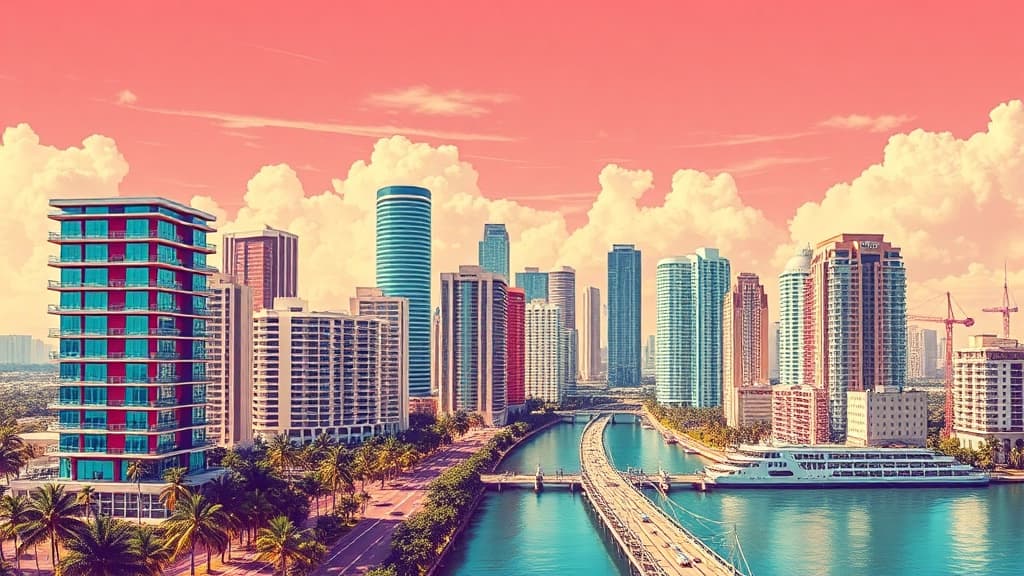
In the gleaming towers of Brickell, conversations flow seamlessly between English, Spanish, and Portuguese as executives from Colombia, Argentina, and Brazil close deals that span continents. This is Miami in 2026—not just a sun-soaked destination, but the beating heart of a $1 trillion trade corridor that connects the United States to Latin America and the Caribbean.
The numbers tell an extraordinary story of transformation. International buyers purchased 49% of new South Florida construction over an 18-month period ending in mid-2025, with a staggering 86% of those buyers coming from Latin America, according to Miami Realtors. By early 2026, foreign investors were driving 52% of new-construction sales, with Colombians leading at 15% market share and Argentines following at 12%.
The New Gold Rush: Latin Capital Floods Miami
What's driving this unprecedented wave of investment? Political instability across Latin America has wealthy families and savvy investors looking north for stability. Under left-leaning leaders like Mexico's Claudia Sheinbaum, Brazil's Luiz Inácio Lula da Silva, and Colombia's Gustavo Petro, capital flight has accelerated, with Miami as the primary beneficiary.
Miami is as popular as ever with buyers from Latin America
ISG World has sales teams actively working in Colombia and Mexico, per Studnicky, reflecting the sustained demand from these markets. The investment pattern skews heavily toward luxury properties over $1 million, with 51% of transactions completed in cash—a testament to the substantial wealth flowing into South Florida.
Brickell: The Wall Street of the South
Brickell's transformation into the "Wall Street of the South" represents more than just clever marketing. International banks and Latin American regional headquarters have made the neighborhood their North American hub, creating a financial ecosystem that rivals traditional centers like Charlotte or Houston in its regional influence.
The infrastructure supporting this role continues to expand. The Port of Miami handles billions in cargo trade with Latin America and the Caribbean, while Miami International Airport has invested heavily in its cargo capabilities, including American Airlines' $500 million Cargo Development Program, according to Schroders research.

American Airlines
American Airlines is the world's largest airline by passengers carried and daily flights, operating thousands of flights to over 350 destinations in more than 60 countries from key hubs worldwide.
Miami-Dade County is planning a new "Americas Gateway Internacional" airport to complement existing infrastructure and further cement the region's role as a hemispheric hub.
The AI Revolution Meets Latin Expansion
In 2026, Miami has evolved beyond traditional trade and finance to become what industry experts call the "AI-powered gateway" between North and South America. The city leverages massive events like eMerge Americas, which draws over 20,000 attendees from more than 50 countries, to facilitate Latin American market expansion in the tech sector.
Local agencies now specialize in cross-border AI applications for finance, trade, and multilingual ecosystems, according to Abbacus Technologies. This technological evolution supports the broader $1 trillion trade corridor by introducing automation and analytics that streamline cross-border commerce.
Political Leadership Embraces the Gateway Role
Miami-Dade's political leadership has fully embraced the city's hemispheric destiny. Mayor Daniella Levine Cava has been particularly vocal about welcoming international investment and refugees from regional instability.

Daniella Levine Cava
Miami-Dade County Mayor Daniella Levine Cava, the first woman to hold the position, guides nearly 3 million residents and a $12 billion budget through rapid expansion and infrastructure demands.
It is incumbent upon us to 'dar la bienvenida' to reflect that we are open for business. We also welcome with open arms those that are fleeing the financial and political desperation
This welcoming stance has practical implications. At the 2026 FII PRIORITY Miami summit, speakers highlighted $4.5 billion in Latin American infrastructure projects including subways and bridges that represent opportunities for U.S. investors—deals that flow through Miami's financial corridors.
Beyond Latin America: Global Expansion
Miami's gateway role extends beyond its traditional Latin American focus. Taiwan is expanding its economic footprint via South Florida as a Latin America gateway, according to UPI reporting, recognizing Miami's unique position as a bridge between multiple global markets.
- Port of Miami: Billions in Latin American and Caribbean cargo trade
- Miami International Airport: $500M American Airlines cargo expansion
- Brickell Financial District: Regional headquarters for international banks
- eMerge Americas: 20,000+ attendees from 50+ countries for tech expansion
- Planned Americas Gateway Internacional: Future airport to expand capacity
The Future of Americas Integration
As political and economic uncertainty continues across Latin America, Miami's role as a safe harbor for capital and talent appears set to strengthen further. The combination of established infrastructure, political stability, cultural familiarity, and now technological innovation creates a compelling value proposition that transcends simple geography.
The $1 trillion trade corridor flowing through Miami represents more than commerce—it's the foundation of a new hemispheric integration that positions the Magic City not just as America's gateway to Latin America, but as the capital of the Americas themselves. In a world of increasing fragmentation, Miami stands as proof that bridges still matter more than walls.