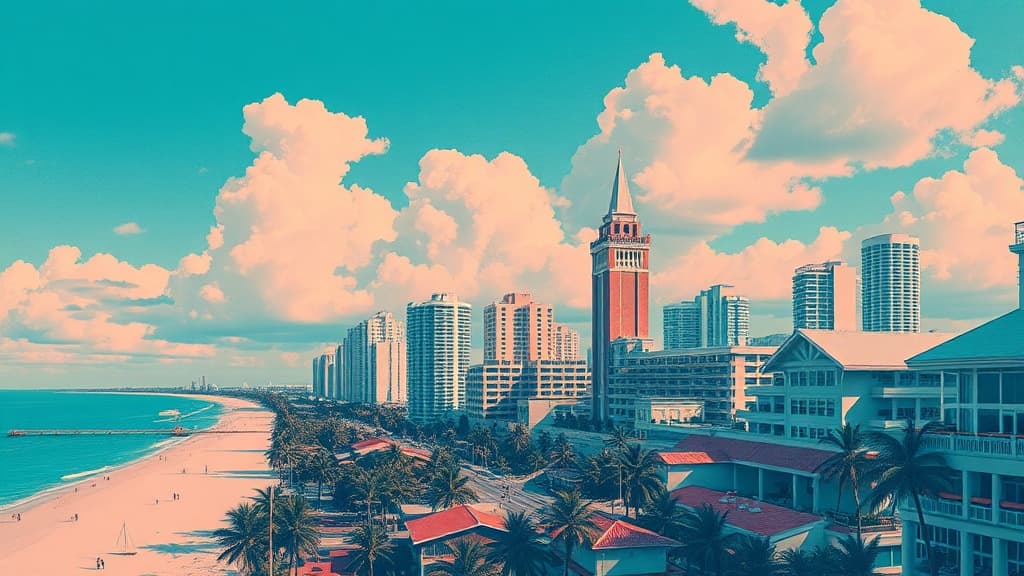
The Miami that welcomed vacationers to its Art Deco hotels and pristine beaches in the 1950s bears little resemblance to the gleaming metropolis that rises from Biscayne Bay today. What was once a modest resort destination has undergone one of the most dramatic urban transformations in American history, evolving into what scholars now recognize as a true global city—a hub where international capital, culture, and commerce converge with an intensity that rivals New York, Los Angeles, or San Francisco.
This transformation didn't happen overnight. It's the product of demographic shifts, economic diversification, international investment, and infrastructure growth that began accelerating in the 1970s and has intensified dramatically over the past decade. Today, Miami stands as America's gateway to Latin America and beyond, a financial center, cultural powerhouse, and increasingly, a technology hub that attracts global talent and capital.
The Foundation Years: From Resort to Refuge
Miami's shift from vacation town began in earnest after World War II, according to Miami-Dade County planning documents. The rise of car culture and resort development transformed Miami Beach into what historians called a "resort metropolis," complete with innovative hotel and motel models that set new standards for hospitality design.
But the real catalyst came in 1959. The Cuban Revolution drove thousands of refugees to Miami, fostering Little Havana as a Cuban cultural center and initiating the cultural transformation that would define the city's character. This wasn't just a population shift—it was the beginning of Miami's evolution into an international city with deep Latin American roots.
By the 1970s and 1980s, international arrivals from Canada, Europe, and the Middle East had rewired Miami's economy from tourism to global trade and banking. Scholars Saskia Sassen and Alejandro Portes recognized this shift early, describing Miami as a "Global City"—a designation that seemed premature at the time but proved prophetic.
This era ended "many accepted ideas of Miami," according to county planning documents, laying the groundwork for economic diversification, higher-density development, and comprehensive downtown redevelopment that would accelerate in coming decades.
The Modern Boom: Building a Global Hub
From the 1990s through the 2000s, Miami emerged as an international hub for trade, art, finance, and Latin American connections. Downtown revitalization filled the skyline with glass towers and luxury condominiums, fundamentally changing the city's silhouette and establishing Brickell as a legitimate financial district.
The numbers tell the story of explosive growth. Over the decade from 2014-2024, the metro area added over 500,000 residents, making it one of the fastest-growing regions in the United States, according to Capital Analytics Associates. This population boom fueled unprecedented demand for housing, infrastructure, and services.
Miami's strategic positioning as America's gateway to Latin America has paid dividends in concrete terms. PortMiami handled $40.3 billion in goods in fiscal year 2023, with top exports flowing to Honduras, Dominican Republic, and El Salvador. Meanwhile, Miami International Airport saw $20.2 billion in trade in the first quarter of 2024 alone, led by exports to Brazil, the United Kingdom, and Chile.
Global Recognition and Investment Magnet
The international business community has taken notice. Miami ranked No. 6 in the 2025 FT-Nikkei ranking for U.S. cities attracting international business, and claimed the No. 1 spot per capita in 2022. The city's combination of strategic location and Florida's lack of state income tax has proven irresistible to multinational corporations seeking a foothold in the Americas.
The construction boom reflects this international confidence. From 2013-2022, Miami added over 12,000 new apartments, ranking fifth nationally for development amid booming construction activity. These aren't just numbers—they represent a fundamental shift in how people view Miami as a place to live, work, and invest long-term.
- Art Basel Miami Beach positioned the city as a global arts destination
- Wynwood Walls created an internationally recognized street art district
- Major tech companies established significant operations in the region
- International banking and finance firms expanded their Miami presence
- Luxury real estate attracted buyers from across Latin America and Europe
The Cultural Transformation
Miami's emergence as a cultural powerhouse has been as dramatic as its economic transformation. The city now blends salsa, reggaeton, and hip-hop in ways that reflect its international character. Art Basel in Miami Beach has become a cornerstone of the global art calendar, while neighborhoods like Wynwood have transformed from industrial areas into internationally recognized cultural districts.
Art Basel
By 2025, the city features what observers describe as "futuristic towers, tech-driven infrastructure, and global influence," representing expansion into technology, finance, and trade that provides economic resilience beyond traditional tourism.
Challenges of Success
Rapid growth brings complications. Wealth migration, remote work adoption, international buyer interest, and climate refugee influx have transformed Miami from a regional market to a "global hot spot," but challenges like housing affordability and infrastructure strain persist.
Perhaps most pressing is climate resilience. Sea level rise threatens the city's future, requiring an estimated $3.8 billion investment over 40 years for stormwater and flooding management, according to research from Vizcaya Museum.
I really think that some of the landscape standards that we have in the city are unlike anywhere else... there is a big opportunity here in Miami to create, and potentially even be this role model for an American city.
The Next Chapter
Engineers and environmentalists are working to adapt infrastructure for climate challenges, emphasizing Miami's advantages as a relatively young city with the agility for sustainable reinvention. Unlike older American cities constrained by legacy infrastructure, Miami has the opportunity to build climate resilience into its continued growth.
The transformation from vacation town to global city represents more than urban development—it's a case study in how strategic positioning, cultural openness, and economic diversification can reshape a metropolis within a generation. As Miami continues evolving, it offers a template for how American cities can adapt to an increasingly interconnected and climate-conscious world.
Miami's success stems from embracing rather than resisting change, leveraging its geographic advantages while building the infrastructure and institutions of a true global city. The question now is whether it can maintain this momentum while addressing the challenges that come with rapid growth.
From the Art Deco dreams of the 1950s to the glass towers of Brickell today, Miami's transformation proves that American cities can reinvent themselves completely within a few decades. The vacation town is gone—in its place stands one of the world's most dynamic and internationally connected metropolises, still writing the next chapter of its remarkable story.